Showing posts with label the kingdom. Show all posts

Thursday, April 28, 2016

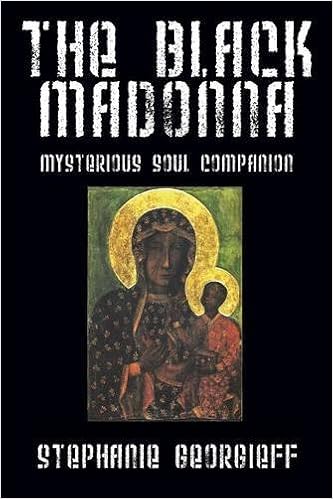
The Black Madonna: Mysterious Soul Companion

Beautiful. Wow. Fascinating. Refreshing. These are but a few of the words that came to mind as I read through Stephanie Georgieff's book The Black Madonna: Mysterious Soul Companion. I found that I was joining the author on a pilgrimage to explore the psychology, science, art, history, and theology in understanding what all these works of art known as the Black Madonna bring to the table. There were were so many new insights and refreshing statements made throughout this pilgrimage. In this literary journey Georgieff introduced a new idea to me that should be shared: That art is a method through which the spiritual world communicates to humanity. As I read those words I immediately thought, "well surely! If God can become incarnate as a human why wouldn't God use art to communicate to us as well now?"

As I continued on to travel through the pages, I could sense a desire to bring healing and The Kingdom of God to earth. I felt that this unearthing of the meanings and history of the Black Madonna led to more of a reason to love God, others, and the earth which we live on. I found that it was a reminder that society's ways of instant gratification and hedonistic self-indulgence is not the way that we were intended to live. Georgieff illustrates this perfectly when she expresses the truth in that, "If one fails to see in another being, or is even forbidden to recognize “The Christ in You,” one is capable of all sorts of immoral behavior." When we get caught up in the ways of society we can often overlook the Image of God that people were created in and if we cannot see that then we unfortunately will be more prone to treat them wrongly. She goes on later to express that, "Christ came to be the brother of humanity, to give humanity true freedom: through His deeds each human being is capable of becoming a working member in the community of the Divine, participating eventually as a partner in the Divine plan of creation. This new relationship is not one ruled from above by cosmic law, but one that is shared through truth and grace." Here again we see the importance of seeking first Christ's Kingdom and becoming co-creators and co-heirs with Christ once we choose that Way of Love and are adopted as God's Children.

As a Protestant reader I was drawn to what Georgieff had to stay about Mary, the Mother of Jesus. I sometimes wonder if the Protestant Evangelical Church has done us a disservice by not talking about Mary or the Divine Femininity much.  I, for one, loved how the author compares Mary as a representation of The Church as the Bride of Christ. She does so by explaining that "The Song of Songs is an allegorical poem showing the deep love between the human soul and the Divine, the longing that the soul has for the Divine, along with the reciprocal desire that the Divine has for the human soul." This is a stance on Mary I have recently been contemplating that she, as the Theotokos, the Human Mother of God, is a representation of Church, humanity, ought to be. Her actions are ones that humanity should have as well. She literally carried Christ within Her and brought Him into the World and we are called to carry Christ within us and share His Good News to all in the World.

There is so much truth, beauty, and healing found within this book. We are reminded of ourselves, of humanity, by studying the Black Madonnas. The Black Madonnas connect us to humanity and remind us of the work we are called to do because they "have suffered, endured great harm, and yet they persist. They are a model for all the downtrodden, the lonely and abandoned. The Black Madonnas offer hope of survival and healing to those who mourn from the pain of racism. The Dark Virgins also offer healing image of the Divine to the racist person, that God can be presented with different face, and that different face is Holy." The Black Madonnas are often shown as having big hands that are pointing downward as if they are saying, "get to work and do something. Plant the seeds of the future." The Black Madonnas are wonderful works of art that are not meant to be worshiped, but I believe are meant to remind us of our callings as followers of the Way of Jesus the Christ. It is to remind us to spread the seeds of His love in the world, work towards reconciliation and the healing of nations which will come in its fullness on the day of Christ's return.
As the book itself ends, I would like to ask, "Who is the Black Madonna? We, humans, are the Black Madonna." How can we get to work and do something about what's wrong in the world today?

Wednesday, March 16, 2016

Be a Witness

  "Now after John was arrested, Jesus came to Galilee, proclaiming the good news of God,15 and saying, “The time is fulfilled, and the kingdom of God has come near; repent, and believe in the good news.” Mark 1:14-15. 

This is the Gospel; the Good News. To repent and and believe for the Kingdom of God has come near. We do not have to go somewhere for the Kingdom of God comes to us. Jesus ascended as a human to God in order that we could be in God's presence again. To allow the Kingdom to come to us.

 This past Sunday's sermon was on this very topic and I had the privilege of hearing it twice. As I sat in my pew I scribbled down as many notes of what the Pastor said that I could. It was an excellent sermon and I felt that God was both up to something then and there and also planting seeds for us to follow throughout the week.

We see signs of the Kingdom in healing, in love, in brokenness being mended, and in restoration. We see the Kingdom of God when we are invited to participate in it. The Holy Spirit has empowered us to do what Jesus was doing: To heal, to cast out demons, to empower others. We are called to be His witnesses in Jerusalem, Judea, and all the Ends of the Earth. What are we doing sitting around waiting til a certain time? We need to go out and do what He has called us to do. As it says in Ephesians he has given everyone different gifts and callings, some to be Apostles, some Evangelists, some Shepherds, some Teachers, and some Prophets. We are all given different gifts in order to participate in the Kingdom in-breaking. Often times when God decides to do something in our lives we only hear how it affects us, personally, but it is so much bigger than us. It is about salvation for the entire cosmos; not just our individual salvation.

How are we being witnesses this week in Lent?

Friday, July 24, 2015

Simplicity

Simplicity.

Some want it. Some hate it. Few have it.

What is it? Is it having a product that combines three of your commonly used items into one device that costs you fortune? Is it getting rid of everything that is unnecessary? Is it a daily life of purging and feeling guilty any time you buy something new? Is it really even about the stuff you own? What is the point of this complex word we called simplicity? Ironic, is it not?

Since my freshmen year of college--and likely since before then in little ways--I have had a fascination with this concept of simplicity. This fascination really began to take root through my ongoing love of community. I found that the more that simplicity was embraced the more community was able to thrive. But what does that mean? Can you have community and also not live a life of simplicity? Yes, but I wonder if we miss out on something. It was Mahatma Gandhi who once said, "Live simply, so that others may simply live." How can we apply this to our lives today?

I recognize that I am writing this as someone who has input in my top strengths. If you are unaware with the Strength Finders 2.0 having input as a top strength simply means that: "You are inquisitive. You collect things. You might collect information -- words, facts, books, and quotations -- or you might collect tangible objects such as butterflies, baseball cards, porcelain dolls, or sepia photographs. Whatever you collect, you collect it because it interests you. And yours is the kind of mind that finds so many things interesting. The world is exciting precisely because of its infinite variety and complexity."1 This strength is very evident as I like to collect books (I have far too many to count), mugs, and old keepsakes. So then, how does one claim to strive towards simplicity when they also tend to have input as a top strength? It is all about understanding simplicity.

Simplicity is put simply an inward discipline with outward lifestyle results. It is a freedom that is found internally which will liberate us in our lives. Richard Foster tells us that when we experience simplicity our speech becomes honest and true, we are freed from a lust for status and position, we cease from showy extravagance out of principle, and our goods become available to others. We lack simplicity when we lack a Divine center or when we feel a lack of security. It is this lack of security and belonging that can lead someone to gain an insane attachment to things.

Simplicity is not about getting rid of everything--although as we heard Jesus' command to the rich young ruler, sometimes that is what is needed to be done. Simplicity, very much like the discipline of fasting, is one that reorients ourselves so that possessions can be rightly enjoyed without destroying us. Most items we own are not inherently bad, but it is all about whether or not they control our lives. If you feel like you could not live without something then maybe it is time to let that go.

The point is not to create legalism on "How much is too much?" or "I have more stuff so I must not be simple enough." No. The point is to seek first the Kingdom of God. When we put the Kingdom of God first in all that we do then everything else will come into place. Ecological concerns, the poor, equal distribution of wealth, and many other things that God cares about will be given their proper attention.

In the end, this inward reality of simplicity is a life of joyful unconcern for possessions. It is a life of putting people above possessions and not accepting society's love of instant gratification. So let us embrace simplicity, not worry about life, trust God, and give what we have to others because God has given it to us to begin with.

If you are a list person (like myself) here is a list of outward signs of simplicity that I found from Richard Foster's book Celebration of Discipline.

  • Buy things for usefulness instead of status
  •  Reject anything that is producing an addiction in you. 
  •  Develop a habit of giving things away
  •  Refuse to be propagandized by the custodians of modern gadgets
  •  Learn to enjoy things without owning them
  •  Develop a deeper appreciation for creation
  •  Look with a healthy skepticism at “buy now, pay later” schemes
  •  Obey Jesus’ instructions on plain, honest speech: Yes be yes, and no be no
  •  Reject anything that breeds the oppression of others
  •  Shun anything that distracts you from seeking God’s kingdom first

1. http://www.gallup.com/businessjournal/688/Input.aspx 
2. I also referenced Celebration of Discipline by Richard Foster and Soul Feast by Marjorie Thompson 

Friday, October 3, 2014

Why Left Behind should be left behind.

I just returned from seeing the Left Behind remake and I am reminded of many memories of my childhood. This poorly done remake focuses solely on the plane ride of those who were left behind after the rapture. This movie was laced with horrible acting, awful implications (such as an elderly woman with Alzheimer's disease getting left behind or the one Arab in the movie being a Muslim who gets left behind), horribly cheesy Christian merchandise on the items of all the Christians, and simply put horrible theology. If that was not bad enough the movie ends [SPOILER] with the plane finally landing, everyone embracing, and the three protagonists, Ray, Chloe, and Buck holding hands as Mark 13:33 plays across the screen. As the credits played to Jordan Spark's rendition of I wish we'd all been ready I could not help but, see the evangelistic theme of the film. It was clear that this horrible theology was turned into a movie to draw in people so they will be scared into Salvation. This worries me and is not how I believe Salvation should work. It may have worked before but, it hardly works now and seems pretty manipulative.

This idea of the rapture comes from Dispensational Premillennialism theology which did not even originate until the 19th century by a Revivalist known as John Nelson Darby. As cheesy as this film was it worries me. The fact that Hollywood finds a need to remake this film makes me worry that people will see this and buy into the theology of escapism. Left Behind and these ideas of the rapture lead to thoughts of the earth--which God created and said was good in Genesis--being evil and meant to be destroyed and that we should be taken from it. This line of thinking can lead Christians to believing we should not care for the earth because one day we will leave it. I find the words of protagonist Chloe Steele in this new adaptation to accurately describe how we should view this theology when she says, "The God my mother talked about would never do this!" 

Instead we should view Revelation as liturgy for what has happened filled with allegories, metaphors, and symbols. We need to view Revelation as we would view the entirety of Scripture: out of a hermeneutic of love. The point of Scripture is God's love and his saving grace. Scripture tells us Jesus is coming to renew this earth that He said was good and building the Kingdom of Heaven here. This is not escapist theology. This is a theology of caring for creation, of loving your enemies and neighbors, of showing everyone what God's love looks like and how we can better build God's kingdom here. A Kingdom without violence, terrors, hate, isolation, exclusion, and destruction. A Kingdom where people are not Left Behind.

For more great resources on this see:
Reading Revelation Responsibly: Uncivil Worship and Witness by Michael Gorman 
http://www.patheos.com/blogs/thepangeablog/2014/06/05/a-raptureless-theology/
Surprised by Hope by N.T. Wright

Wednesday, August 27, 2014

Pondering on Atonement

For the past several months I have been wrestling with Atonement theories. I have grown up hearing the idea that Christ had to come down and take the place on the cross for our sins. We quote Bible verses such as, "“For God so loved the world that he gave his only Son, so that everyone who believes in him may not perish but may have eternal life" (John 3.16, New Revised Standard Version) and translate it to mean that Christ took the place to satisfy an angry God. Or there is the theory that God in His love could not be near sin so sent His Son to die and destroy Sin so that we may be able to be purified and enter into His presence. There are many theories of Atonement and I would agree with the theologian Tony Jones that many of them likely got some aspects right but, not all.

But I would like to present another idea one that very likely is not original but, has been on my mind. What if the reason why Jesus became human and allowed himself to die on a cross was to show us that He loved us enough to become like us and die the worst possible death that we could experience. He came simply to suffer with us, love with us, dwell among us. He wanted to show he was not some far off, transcendent God who did not care. This would show us that if the Son of God is able to come down and go through this we should not be discouraged and should follow His example of the life He lived. It seems to me that we often stop atonement theories here. We say the Cross is what it's all about but, here's the problem with that: if the Cross is all that matters then we are hopeless. All that the Cross shows us is death. If the story ended with the Cross then it would end with Jesus' death but, we know the story does not end there. Three days later Jesus is resurrected and what if His resurrection is to show the resurrection that will await us in the age to come? What if Jesus was saying, "Just as I have loved the best I could until my death--and had the worst kind of death--so can you and if you will do as I have done you will to be resurrected." That is the good news. That Jesus is inviting us to live the life of the Resurrection. He is inviting us to choose life, reject evil, love the unlovable, love the lovable, and spread the good news of the Resurrection as we await that day where Christ returns to be fully here, fully reigning on earth as it is in Heaven.