Showing posts with label church. Show all posts

Tuesday, April 5, 2016

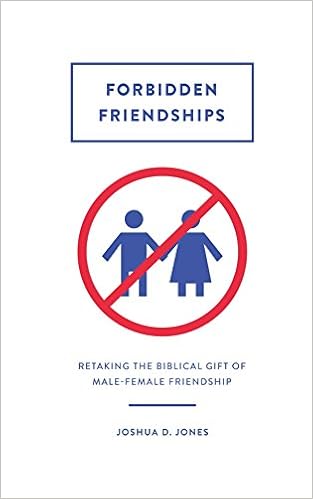
A Family of Families: A Review of "Forbidden Friendships."

I recently read the book “Forbidden Friendships:Retaking the Biblical Gift of Male-Female Friendship” by Joshua D. Jones and I found it to be an excellent resource on how we, as Christians with integrity, should respond to our culture; and I would greatly recommend it. Once I sat down and started it I kept being drawn to read more. I found this book to be an excellent look at male-female friendships and how for the sake of integrity we have lost the goodness that they bring to the table. I loved how he begins by addressing the boundaries we create for male-female relationships that cause male pastors to connect really well to males, but not to females and vice versa. It has good intentions, but has gone too far. There were so many rich quotes all throughout that I found the best way to review this book would be by looking at a few of them.


I would like to begin with the quote that I find summarizes most of the book in an excellent way. This is when Jones says, "We are now brothers and sisters. Christ’s work transforms the full spectrum of human relationships be they between race, class, age or gender.” Within the Church we need this reminder for the sake of integrity and equality. Paul tells us that we are neither male nor female, Jew or Gentile and so we need to stop letting our culture’s oversexualization prevent us from being the Church as brothers and sisters together. From the very beginning of the book there is this focus on how both males and females have something to bring to the table and by segregating them we do a disservice to each other and towards our mission to work towards God's Kingdom here on Earth. We are both made in the image of God, so we should work together to further the Kingdom and not separate.

“We are called to be the Family of God. But we often seem more like of a collection of families who fail to celebrate celibacy, deep friendships and opposite-gender relationships - other than marriage - of any sort. I don’t know of any man who has “too many” female friendships. I don’t know of any Christian woman who loves men “too much”." This quote shows us the importance of highlighting that we truly are meant to be a Family. We are meant to be brothers, sisters, uncles, aunts, fathers, and mothers to those within the Church body. That is how a lot of healing takes place especially in broken families. We need to be a family to those coming to Christ from all paths of life.

I did find that it was worth noting that our current state within the church “is quite a sharp contrast to the second and third centuries in the Church when friendship was exalted and marriage belittled. Then it was celibate culture which dominated Christianity and married people struggled to fit in. Fortunately, early church leaders like John Chrysostom and Augustine (both celibates themselves) wrote on the sanctity of marriage and helped to save Christianity from becoming a singles club.” It appears we have bounced from one extreme to another and we, as the Church, need to find a middle ground. We need to both affirm celibacy and marriage as both good in the eyes of God and both ways to live within the Church Body.

Within the Church we need to be affirming, welcoming, and even encouraging to both paths of life: those who pursue marriage and those who pursue celibacy. Jones reminds us that, “When God’s Church accepts and affirms people in their celibacy (whether it is chosen or not) it is a sign to the world around us that God’s future Kingdom is breaking through among us now. It is a step towards living out relationships “on Earth as it is in Heaven.” This does not mean that a celibate life is superior to sex and a married life (as some in the past have thought) but it is a sign that another life force is present with us, enabling some individuals in our midst to live without those things." We need to realize we are in the “already and not yet” and stop just focusing on the “not yet.” We need to remember that the Crucifixion and Resurrection began the ushering in of the Kingdom and we need to already begin living like the Kingdom is breaking in...because it is!

In establishing this model of being a Family of God we should pursue this idea of anamchara that the author discusses. He talks about how we should have a “goal of mentoring someone” which would lead to having “a spiritual friend and co-worker in mission. A part of this large history of spiritual mentoring is represented by the Gaelic word anamchara or “soul friend”. An anamchara was one you intimately engaged with for the purpose of edification. Anamchara was often initiated when one of the two was a more mature, mentor figure. Even when it started as a mentorship, however, the goal was to grow up together into friendship in Christ.” Our goal is equal friendship within the family.

I have found overall this book to be a wonderful call towards embracing the Truth that we are called to become a Family of God and that within that we do not need to pursue marriage over celibacy or vice versa. We need to affirm both callings in life and find ways to be anamcharas to others within our world. It is also important to end this post with the reminder that the book ends with: Yes we were made for community, yes it is not good for “man to be alone”, but ultimately no person--spouse or friend--can truly ever satisfy the longing within our soul. The longing for our Creator, our Sustainer. That longing can only be fulfilled by the Trinitarian friendship that we will one day be whole with. So lets let our “true inter-gender friendship...be one of the most powerful apologetics for the gospel we can display in the 21st Century.”

Wednesday, February 17, 2016

What is it that We believe?

Lent. Week 1. Day 4. The day that people are beginning to see how hard their fast is. That some people have already given up and thrown in the towel. The day that others are moving along as if their Lenten fast is their New Years Resolution that they are still following. It is still the beginning and yet we are moving farther into this 40 day journey.

To begin my Lenten season I had the privilege of preaching at the church that I am employed at. I began our churches Lenten series on the Apostle's Creed by analyzing the why of what we believe. As someone who enjoys blogging I have decided during this Lenten season to post one blog a week about my experiences during Lent. I find this season to be a great time for reflection and drawing close to Jesus. As my church goes through our series on the Apostle's Creed and analyzing what we believe I too want to share my thoughts on the Creed via this blog.

To share my thoughts this week I would like to share an excerpt from my sermon I shared this pass Sunday. The Sermon lesson was on Luke 4:1-13 on Jesus in the Wilderness.

"We believe...what is it that we believe?

Throughout this Gospel passage we witness Jesus’ immediate actions after his baptism. He goes out and follows the guidance of the Holy Spirit into the Wilderness. This is pretty important because a lot has happened in the wilderness. One time that comes to mind is when the Israelite's fell in the wilderness and had to be there for 40 years. And now we have Jesus going to the wilderness for 40 days to fast. Jesus did this because he knew what He believed and who he was. The beloved child of God sent here on a mission to save humanity.

Jesus was tested and could overcome these temptations because he knew what he believed. He was tempted to give into doubt and not believe that God would care and provide for him, tempted to give into false worship in order to have control and do what he felt would be best, and tempted to test the trust that he had in God. These are some of the same temptations that so many of us face today, but he overcame them because he knew what he believed.

He knew what he believed...I’m saying that a lot, but that’s pretty important, to know what and why we believe what we believe. That’s the very reason why we have teenagers go through confirmation. To know what and why we believe what we believe. 

Throughout the next couple weeks as we go through the time of Lent--the 40 days before Easter--we are going to be studying the Apostle’s Creed. This is a Creed, a Statement, of what we as a body agree that we believe. It is very fitting that we would take 40 days to study what we believe, to maybe even fast, in order that we could live a life of discipleship by pursuing the kingdom...when we live this life we will be able to overcome temptation because we trust in our Lord and know what we believe. There are some preachers out there who will say Christianity is easy and there is no temptation. They’re wrong. Temptation comes and we need to overcome it, in order to do that we need to know what we believe. If the SON OF GOD goes through temptation I am pretty sure a regular Christian Joe will too. So following in Jesus’ example we are learning and growing towards the Father for 40 days. 

During this time there may be times of doubts and questions. Those are not inherently bad. That is why community is so vital and important. Community and relying on God. When we are alone temptation will come even harder then when we are with people. We are allowed to doubt, but what we want to avoid is giving into the doubt, giving into the temptation to say, “none of this makes sense so I give up and I am moving on.” We are studying, together as a body, what we believe in order to fully stand against temptation that the Accuser throws our way and in order to live out what we believe.

Creeds help us do this. They remark each week what we believe and remind us that we are in this together. This isn’t just some lone loon who happens to believe this ancient guy, but we are stating that we believe the same truths that people have believed for hundreds of years! It unites us in our belief and even Jesus, God made flesh, unites himself with us. He came down to be like us and just like we are often, he was tempted by the Accuser.

So this passage we read, it is perfect for beginning our series and beginning this season of Lent. Many people choose something to give up for Lent as a way of refocusing on God. They choose something to give up that may be holding them back from God and take time to grow closer to God. It is a time to show us, like Jesus stated, that man does not live on bread alone. We need God more than many of us are comfortable admitting in this world of independence and individualism.
We don’t like needing someone. It is in these times of individualism that temptation can most strike.
This is a time to say, “yes I need the Father. I need what I confess to be true. I don’t need food, I don’t need coffee, I need the Father. I need to seek the Kingdom and everything else will fall in line.”

*References from NT Wright's Luke For Everyone Commentary. 

Monday, April 13, 2015

Searching for Sunday

As someone who has grown up in the evangelical tradition, had an awesome upbringing, and since I have been in college has found a love for liturgy and the mainline traditions I have found that Rachel Held Evan's new book Searching for Sunday: Loving, Leaving, and Finding the Church was an incredible and refreshing read. This was an incredible read that was beautifully written and probably Rachel Held Evan's best book so far! I was not able to put the book down and found myself reading it every where I went. I loved how she so authentically shared her journey of leaving and then finding a church where she can belong and feel loved simply for showing up. Sometimes it can be so easy to get caught up in how the worship is or what kind of music they play, but at the end of the day it is completely about the people there. It is about the community and how loving they are. This past Sunday I visited a church in town and I was overwhelmed (in a good way) about how friendly and welcoming they seemed to be. I could tell that the church knew that my fiance and I were visitors and they wanted us to feel welcomed and as if this was a place we could return to and belong at. From the very beginning people told us that we should come, get involved, become members, and find our niche in ministry. We could tell that this was not a place of just coming to church on Sunday, but that it was a place we could belong to. We could tell all of this just from the people we met that day. It felt like such a blessing I almost cried--which granted is not a big deal for me, but still.

 The book did an excellent job at showing that she still loves evangelicalism and would never completely give it up. I felt this book emphasized the importance of denominations, the sacraments, and unity without uniformity. Searching for Sunday helps one gain a better appreciation for the sacraments of: baptism, confession, holy orders, communion, confirmation, anointing of the sick, and marriage. There were chapters I cried in, laughed at, and underlined in at least 10 times in. Most of the margins have notes and scribbles affirming what was read in the book. This may be the best book I have read in awhile and it is a great one for anyone questioning how they view the Church or even how the church should be. There are examples of so many types of churches. This is a call to not leave the church--or even to leave a particular denomination, but to find the beauty in the Church universal. To realize that the Church is messy, confusing, and ongoing, but it is the Bride of Christ. As Rachel so eloquently writes, "All we have is this church--this lousy, screwed-up, glorious church--which, by God's grace, is enough."


Interested yet? Searching for Sunday comes out on April 14th, tomorrow, so order it now at www.searchingforsunday.com 

Friday, April 10, 2015

Be fruitful and Multiply: The Great Commission

“God blessed them, and God said to them, “Be fruitful and multiply, and fill the earth and subdue it; and have dominion over the fish of the sea and over the birds of the air and over every living thing that moves upon the earth” (Genesis 1:28, New Revised Standard Version).

Genesis 1:28. The Biblical mandate humanity was given in this creation narrative. The Biblical mandate that is so often used to tell Christians why they must have kids. Why it is the duty of good married couples to procreate. This verse has plagued many couples who do not feel a calling to have children or may not be able to have children. This verse has been both a blessing and a curse to people, but I wonder if we have missed the point. Have we viewed this passage in a simplistic way by limiting it to procreation?

I am not in any way saying procreation is not a good and godly thing, but what is truly its purpose? Are we just meant to populate the earth and then would that not make it irrelevant now in our overpopulated world? Or is the purpose to represent the church as people of the Kingdom. When we make a family we are making little Kingdoms. Alexander Schmemman in his book For the Life of the World: Sacraments and Orthodoxy says, “Family is a big part of the sacrament of matrimony because each family is a kingdom, a little church, and therefore a sacrament of a way to the Kingdom (Kindle loc. 1293).The purpose of having a family is to be little churches, but those little churches are not meant to be alone. Those churches are called to minister in their context and also gather together with other churches or families.

In these gatherings we can share what our church has done and equip new people to go out and start their own churches. That does not mean that everyone must go out and have kids to start a family. What it means is that people should go out and be the church. When people start and multiply churches it is the same as starting a family. If we are truly being the church we should be like a family. When we equip and send people out we have reproduced people to go out and be a family in a context we could never reach.

Viewing procreation as a means of creating little churches allows us to see this passage of Scripture in a larger more meaningful way. I wonder if when God created humankind in His image and gave us this command if it was more of a command to be the church. God is calling his people to go out and build the kingdom. We see this mandate all throughout Scripture and we are reminded of it through the words of Jesus in the New Testament when he says, "Go therefore and make disciples of all nations, baptizing them in the name of the Father and of the Son and of the Holy Spirit, and teaching them to obey everything that I have commanded you. And remember, I am with you always, to the end of the age" (Matthew 28:19-20, NRSV). Jesus is not calling us to something new. This is not a radical new lifestyle. This is showing us what He intended from the beginning. So we are all--married, single, celibate--called to make disciples, to multiply and fill the earth with the love of God which ushers in the Kingdom.

The point of the Church is not to make one little group and leave it in that community. The point of the Church is to equip and empower others in your group to start other groups. If we are to be the Body of Christ, we must be allow the Spirit to work in us and fill us with fruits of love, joy, peace, patience, generosity, faithfulness, gentleness, and self-control. When these fruits are present in our lives it will naturally lead us to go and multiply the Church. To lead others into the life giving freedom of the Kingdom of God.

Sources:

Schmemann, Alexander. For the Life of the World: Sacraments and Orthodoxy. Crewstwood, NY: St. Vladimir's Seminary, 2000. Print.

Sunday, January 4, 2015

My date with the Episcopal church

Have you ever met someone who you knew you had to get to know and date? The more you got to know them the more you knew that you had to be more than friends with this special person who just happened to come into your life. Slowly as time wore on you began developing many expectations for this person and what your dating life would be and by the time that you had your first date planned you had already picked out the name of your first born child with this person. Then that fateful day happens when you go on this long-awaited date and...it blows. Nothing met your expectations and you realized that you had fallen in love with the idea of this person, but not the actual living, breathing, person. Has this ever happened to you?

It happened to me, not with a person, but rather a church; the Episcopal church to be exact. 

My tale begins my sophomore year at the University when I first began to hear about the Episcopal church and their theology. The more I learned the more I found myself agreeing with and the more I wanted to learn. I began researching their theology and even attending one of their prayer walks for Good Friday during my junior year in college. I had yet to actually attend one of their Sunday morning services, but I was increasingly impressed with their theology and how missional they tended to be. I then discovered that they help start and fund the local homeless shelter which made me respect them even more. Around this time I had been introduced to other High Church settings through the Lutherans and Catholics and fell in love with liturgy. Eventually I felt it would be time to finally check out an Episcopal service.

I anxiously walked towards the door next to my lovely fiance. She smiled at me handing me a piece of gum with a joke of, 'this is for if she--the church--kisses you.' This was how I knew that she approved of this first date with this lovely church. As I sat in and participated with the community in the service I started to feel as if I was cheating on my home church that I attend when I am at school. Over time I realized that I was greatly enjoying the liturgy and the message, but something did not feel right. The service was great, but I did not feel like I was at home. I realized I had fallen in love with the theology of the Episcopal church, but I missed the excitement and lively music from my own evangelical church. I enjoyed myself, but my expectations were not completely made and I realized that this type of service did not draw me in and was more of an occasional when I need a break from routine type of service. I realized that I was drawn to more of an evangelical feel and that it was okay for me to be. I do not have to follow the trend of millennials and just leave a church that does not seem to have everything figured out, because there is no such thing as a perfect church. 

So attending the Episcopal church was a good and growing experience for me; it was one that I needed. It showed me how much I value the church I currently attend and it showed me that just because I love a churches theology does not mean that I need to attend that denomination or would like all of their polity or the way they do their services. This is what I needed for my growth in Faith.

Lord, I pray for unity among all denominations that we would be able to learn from each other and share what we have with one another. Let us all live in love.

That was the tale of my date with the Episcopal church. I look forward to serving alongside the Episcopal church as my years in ministry continue.